AI in project management: what an assistant can do — and what it can't
Expectations of an AI assistant in project management are usually too high and too low at the same time.
Too high, because many hope it will take the deciding off their hands. Too low, because it genuinely helps with the boring work — and the boring work is what eats the hours.
What it is good at
Splitting. "We want to offer payments" is not a ticket, it is an intention. Turning it into eight concrete activities is legwork with a known pattern. A model that has seen a thousand project plans does it in seconds — and forgets the unglamorous step less often than a human on a Friday afternoon.
Finding gaps. Looking at your own project, you see what is there. An assistant also sees what is missing: no ticket for the data migration, none for training, none for the way back if it goes wrong.
Phrasing. "Login broken" becomes "Sign-in fails when the email address contains umlauts". No thinking, but work that otherwise nobody does.
What it cannot do
Prioritise. What comes first depends on things recorded nowhere in the project: which customer is wobbling, who is on holiday next week, what management is watching. An assistant that proposes an order is guessing.
Estimate effort. It doesn't know your legacy system, the person who will get the ticket, or the three surprises that always turn up in exactly that area. Its numbers are a starting point for a conversation, not a result.
Carry responsibility. If a proposal was wrong, somebody still accepted it.
The rule that decides everything: propose, don't execute
An assistant that creates, assigns and moves tickets by itself feels powerful — until the first misunderstanding. Then ten tickets nobody wanted are sitting on the board and somebody spends half an hour clearing up.
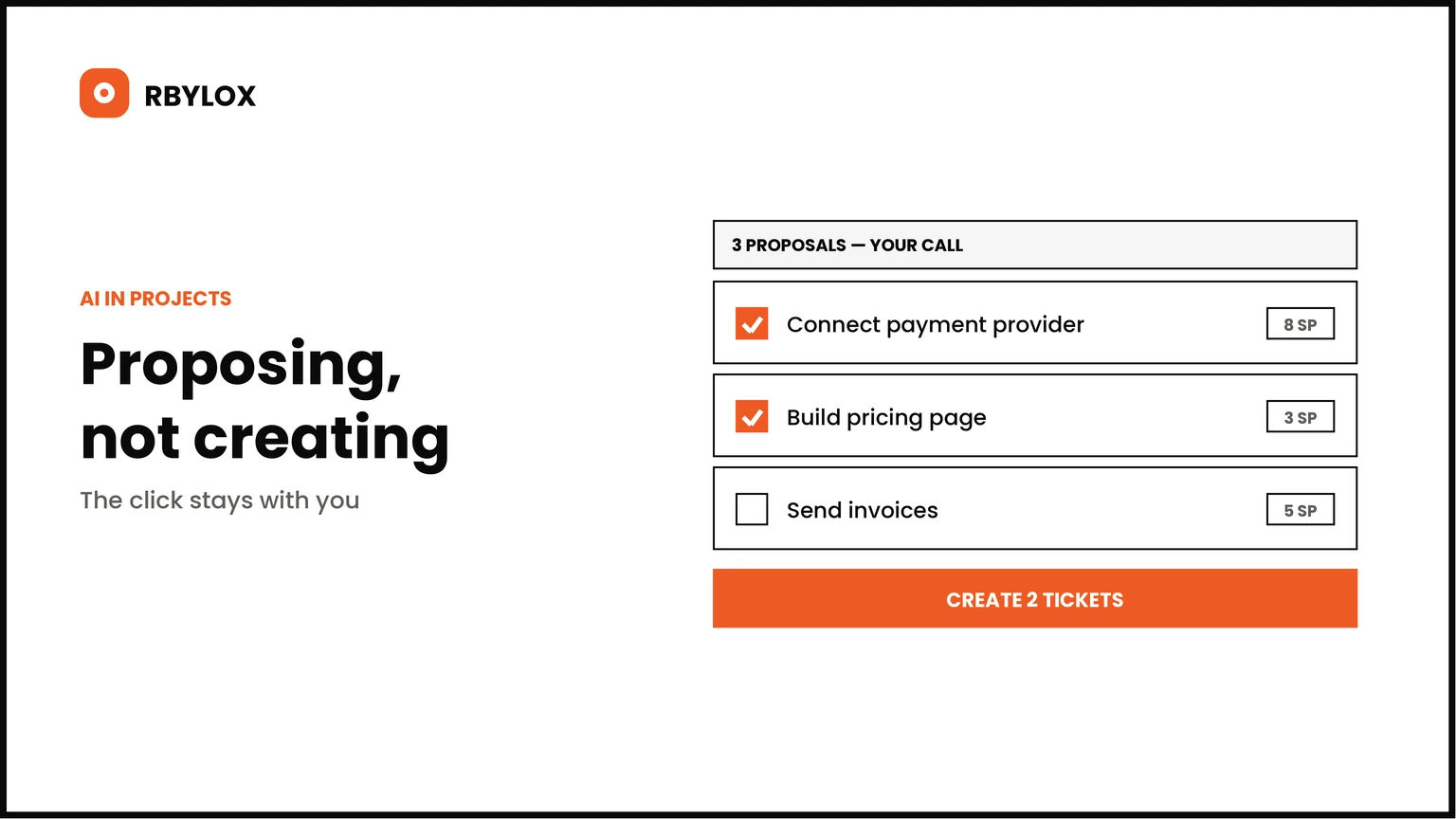
So: the assistant proposes, the proposals appear as an individually deselectable list, and only a click creates them. That costs three seconds and saves the cleanup.
The side effect matters more than the obvious one: reviewing a list before it becomes reality makes you think along. Finding a finished list makes you accept it.
Two things to settle beforehand
What does it see? An assistant that is meant to be useful needs the project: tickets, status, who is on what. Which means those details leave your own server. Comments, files and chat histories do not have to go with them — the less that travels, the less there is to weigh up.
Where does the key live? On the server, never in the browser. Everything shipped to the frontend is publicly readable, including an API key, which will then be spent on someone else's behalf.
The honest benefit
An assistant does not turn a bad project into a good one. It relieves nobody of the question of what should actually be built.
What it reliably takes away is the half hour in front of an empty board — the moment when you know what needs doing and have no appetite for typing it into fourteen tickets. That sounds modest. It is the point where most projects actually get stuck.