Work Breakdown Structure: splitting projects that would otherwise tip over
"How long will this take?" — "About three months."
That answer is almost always wrong, for a simple reason: nobody can estimate three months. People can estimate two days. A Work Breakdown Structure turns one three-month question into sixty two-day questions.
What a WBS is
A hierarchical split of the project into smaller and smaller parts — until the bottom level holds packages one person can finish in a manageable time.
Important: a WBS splits deliverables, not activities. Not "do the coding", but "sign-up form, tested and working".
The structure
Every level gets a number. It looks bureaucratic, but it is the reason you can say "we are at 2.3.1" in a meeting and everyone knows where they are.
1     New website
1.1   Content
1.1.1 Home page copy
1.1.2 Product page copy
1.1.3 Select and cut out images
1.2   Build
1.2.1 Project scaffold
1.2.2 Home page
1.2.3 Contact form incl. delivery
1.3   Go live
1.3.1 Domain and certificate
1.3.2 Redirects for old URLs
1.3.3 Analytics and Search Console
The 8/80 rule
A work package should be between 8 and 80 hours.
- Under 8 hours: too small. You spend more time managing than working.
- Over 80 hours: too big. Progress stops being measurable — the package is "about 70% done" for weeks.
Between those bounds you can estimate instead of guess.
The 100% rule
The children of a node add up to exactly that node. No more, no less.
Sounds obvious. It is not. The most common planning failure is that "1.3 Go live" is missing the redirects — and three weeks after launch, search traffic collapses because every old URL leads nowhere.
So at every node, ask once: what belongs here that is not written down?
What a WBS is not
Not a schedule. The WBS says what, not when. Order and dates come afterwards.
Not an org chart. Who does the work is assigned later. If you shape the split around people, you get packages that match responsibilities instead of results.
A worked example
Take the contact form above, package 1.2.3. At a glance: "one day".
Split out:
| Part | Hours |
| Design and place the form | 4 |
| Required fields and error messages | 3 |
| Set up delivery, test it arrives | 4 |
| Spam protection | 3 |
| Privacy notice and consent | 2 |
| Test on phone and tablet | 2 |
Eighteen hours. Not eight. The difference is not pessimism — it is the parts nobody thinks of when estimating in one go.
That is exactly what a WBS is for.
How to start
- Write down the end result. One sentence.
- Split into three to seven large chunks. No more.
- Split each chunk further until the 8/80 rule applies.
- Walk every node: is anything missing?
- Only then: estimate, sequence, assign.
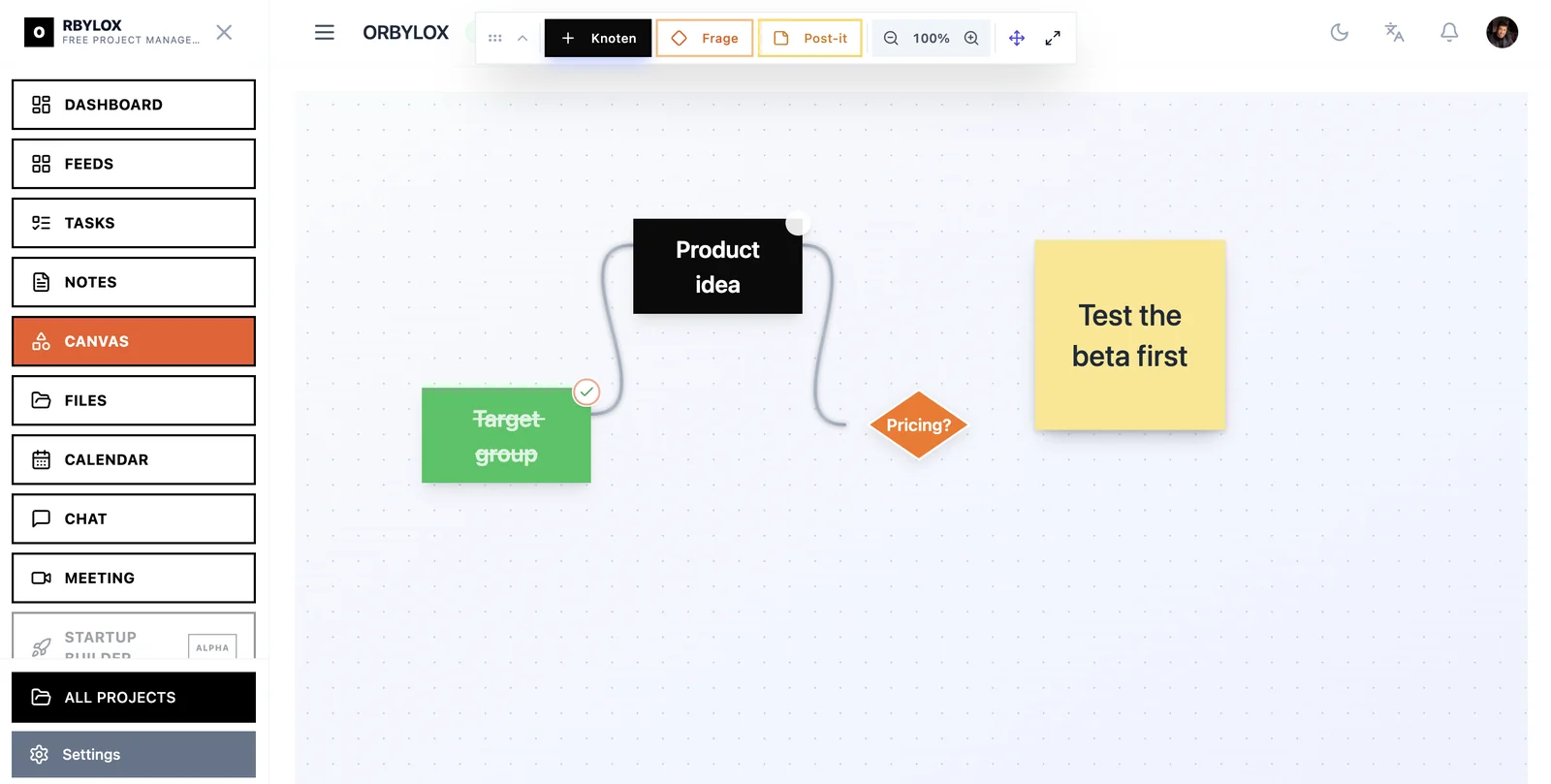
In the ORBYLOX canvas you can build this structure as a tree and turn the packages straight into tickets — so the breakdown stays connected to the work.