Project risks: five is enough
Risk management has a bad reputation in small teams, and deservedly so: it usually shows up as a forty-row table that is filled in once and never opened again.
That is a shame, because the useful core fits on one page and costs twenty minutes a month.
A risk is not a problem
The difference is tense, and it decides what to do.
| Risk | Problem | |
| Tense | might happen | has happened |
| Question | How likely, how bad? | Who fixes it by when? |
| Belongs in | the risk list | the board, as a ticket |
The most common mistake in risk lists is that half the entries are already problems. Those do not belong in the list, they belong in the work.
Five, not forty
A risk list with forty rows says nobody prioritised. Five is the right number — the five where you would actually do something.
Anything below that costs maintenance and returns nothing. If a sixth seems important enough, another one drops out. That is not sloppiness, that is the actual work.
Rating without false precision
Two questions, three levels each. No percentages, no scoring systems with decimal places — they fake a precision that does not exist.
| low | medium | high | |
| Likelihood | unlikely | could well happen | expect it |
| Impact | a few days | the date wobbles | the project fails |
Which gives the matrix:
| Impact low | medium | high | |
| L. high | watch | act | act |
| L. medium | accept | watch | act |
| L. low | accept | accept | watch |
Three cells say "act". If more than two of your risks land there, the project is cut too large.
Four ways to respond
For every risk in an "act" cell, one is chosen — and written down:
Avoid. Change the plan so the risk disappears. Most expensive, most certain. Example: take the boring interface instead of the untested one.
Reduce. Lower the likelihood or the impact. Example: test the risky assumption early instead of late.
Transfer. Someone else carries it — contract, insurance, supplier. Rarely worthwhile in small projects.
Accept. Deliberately do nothing, but know it is there and hold a plan B. Entirely legitimate, as long as it is said out loud.
What is not an option: record it and move on. A risk without a chosen response is a note, not a measure.
Template to copy
| Risk | L. | I. | Response | Who | By when |
| Client does not sign off the design in time | high | med | reduce: fixed deadline at kickoff | Jey | Sep 24 |
| Photos fail in bad weather | med | low | accept, backup date in calendar | Tom | — |
| Booking takes longer than estimated | med | high | reduce: start early, core first | Jey | Sep 30 |
| Accountant does not respond | low | high | reduce: approach a second firm | Jey | Oct 6 |
Six columns, four rows. The last two make the difference: a risk without a name and a date does not get worked on.
When to review
Every two weeks, ten minutes, in the same meeting as the status report. Three questions:
- Has one of them happened? → out of the list, onto the board as a problem.
- Has one become less likely? → downgrade or delete.
- Has something new appeared? → then something else drops out.
A risk list that does not change over three months is not stable — it is not being read.
In ORBYLOX
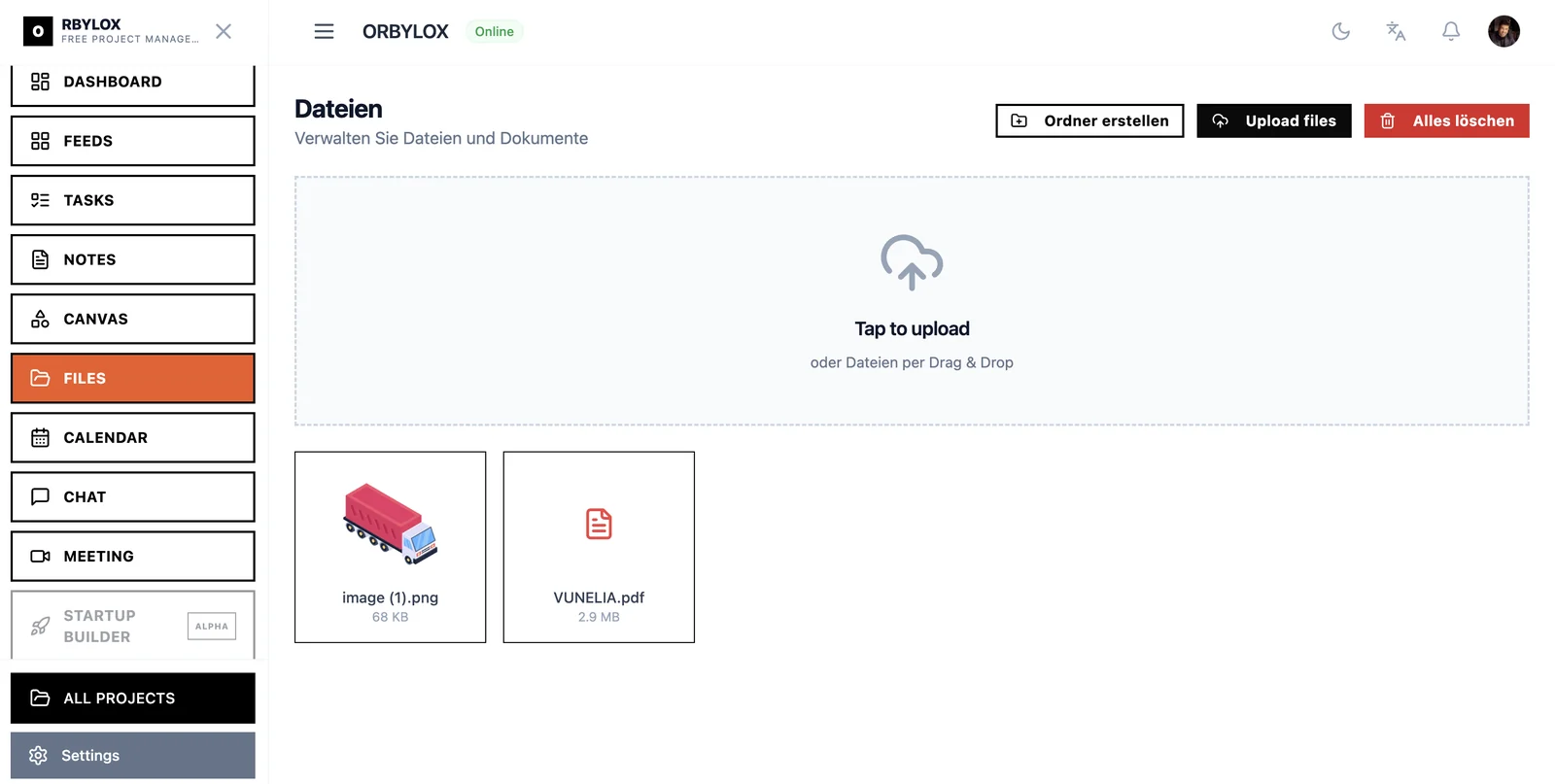
The list lives as a note in the project. Every risk in an "act" cell also gets a ticket with an owner and a due date — otherwise it stays a row in a table, and nobody works on rows in tables.
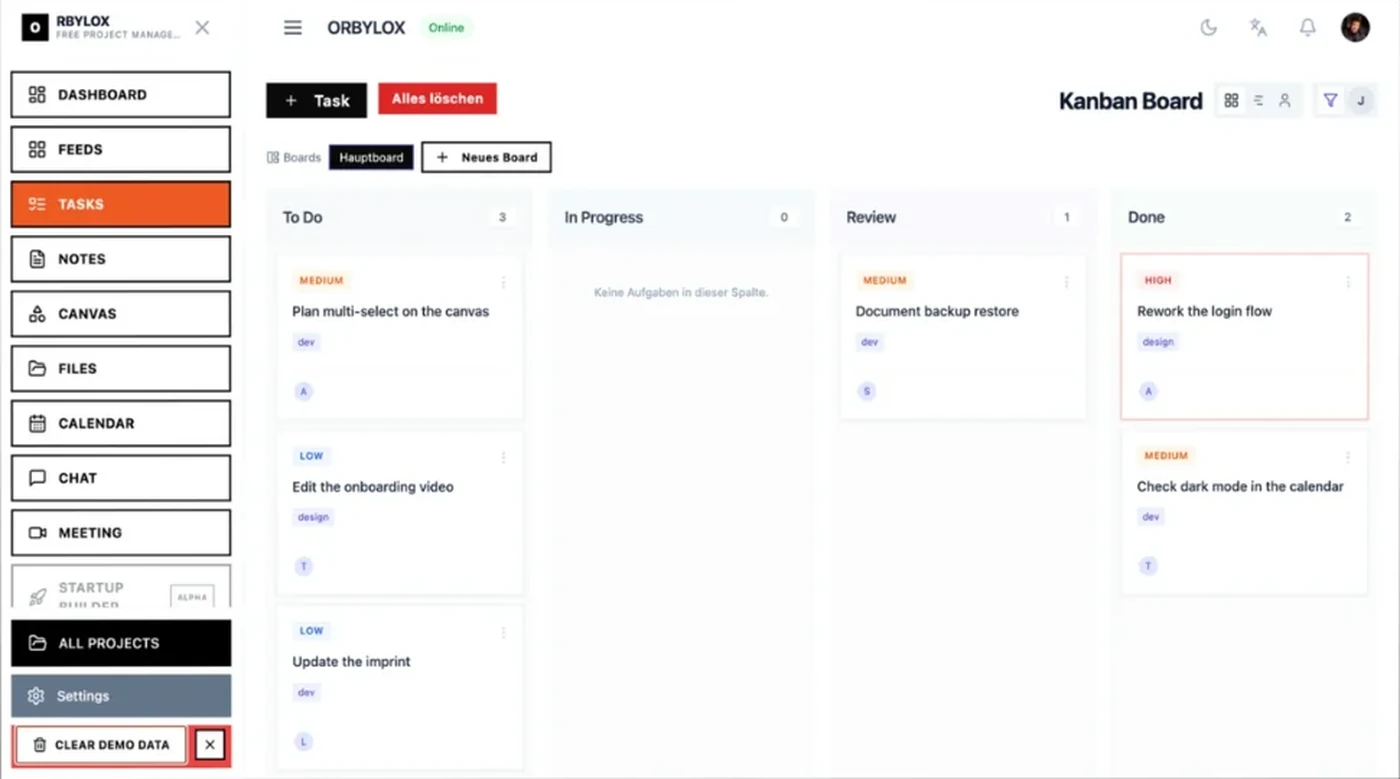
If a risk materialises, the ticket moves onto the board and becomes ordinary work. The deadline reminder handles the date so nobody has to remember it.