Project status report: three questions, half a page
A status report nobody reads is more expensive than no report at all: it costs the time to write and still produces no clarity.
The problem is almost always the same. The report describes what the team did. What matters is where the project stands — and whether anyone needs to act.
What a status report has to answer
Exactly three questions. Adding a fourth makes the report longer without making it more useful.
- Are we on plan? Yes, no, or barely — with a number, not a feeling.
- What is blocked? And who has to unblock it.
- What changes? Date, scope or cost — or explicitly: nothing.
A report that answers all three fits on half a page. Anything beyond that is minutes, and minutes belong somewhere else.
Traffic lights, used properly
Green, amber, red are useful when they are defined — and useless when everyone means something different. Agree once on what they mean:
| Colour | Means | And asks for |
| Green | on plan, no help needed | nothing |
| Amber | date is wobbling, we will fix it | acknowledgement |
| Red | date will slip, we cannot fix it alone | a decision |
The decisive column is the third. Red without a concrete request is not an alarm, it is complaining — and by the third time it gets ignored.
Amber is the most important colour. Projects rarely jump from green to red. They sit on amber for weeks and nobody acts, because amber looks like "it's fine". Anyone reporting amber twice in a row should report red the third time.
Template to copy
Project: Café Morgen website Week: W38 · Status: 🟡 Amber (second week)
On plan? 14 of 20 work packages done. 16 were planned. Behind by two packages, roughly four days.
What is blocked? Table booking is waiting on sign-off for the homepage design. It has been with the client since Monday. → Request: response by Wednesday, otherwise the opening moves.
What changes? Date: unchanged, Oct 15, but with no buffer left. Scope: the English version is dropped (agreed with the client on Sep 12). Cost: unchanged.
Next week: Finish booking, add photos, legal pages back from the accountant.
That is the whole report. Five minutes of writing, and every line answers one of the three questions.
The three most common mistakes
Activities instead of position. "We worked on the booking form" says nothing. "Booking: form done, confirmation email open, 60 percent" says something. The difference is whether you can derive a date from it.
Blockers without an addressee. "Waiting for sign-off" is an observation. "Waiting for sign-off from Ms Berger, since Monday, blocking four days of work" is a request. Only the second form triggers anything.
Green until the bang. Reporting green week after week and then red two weeks before the deadline is not bad reporting — it is no reporting. A status report is an early warning system, or it is decoration.
How often?
Weekly if the project runs shorter than six months. Every two weeks beyond that.
Daily is not a status report but a standup — that one is spoken and goes to the team, not to management. Monthly is too rare: a problem that grows unnoticed for four weeks is no longer a problem, it is a date.
Who gets it?
The smaller the distribution list, the more honest the report. Someone who knows twelve people are reading writes more carefully — and careful reports are the useless ones.
Rule of thumb: the list consists of people who could react to "red". Everyone else gets the report on request.
In ORBYLOX
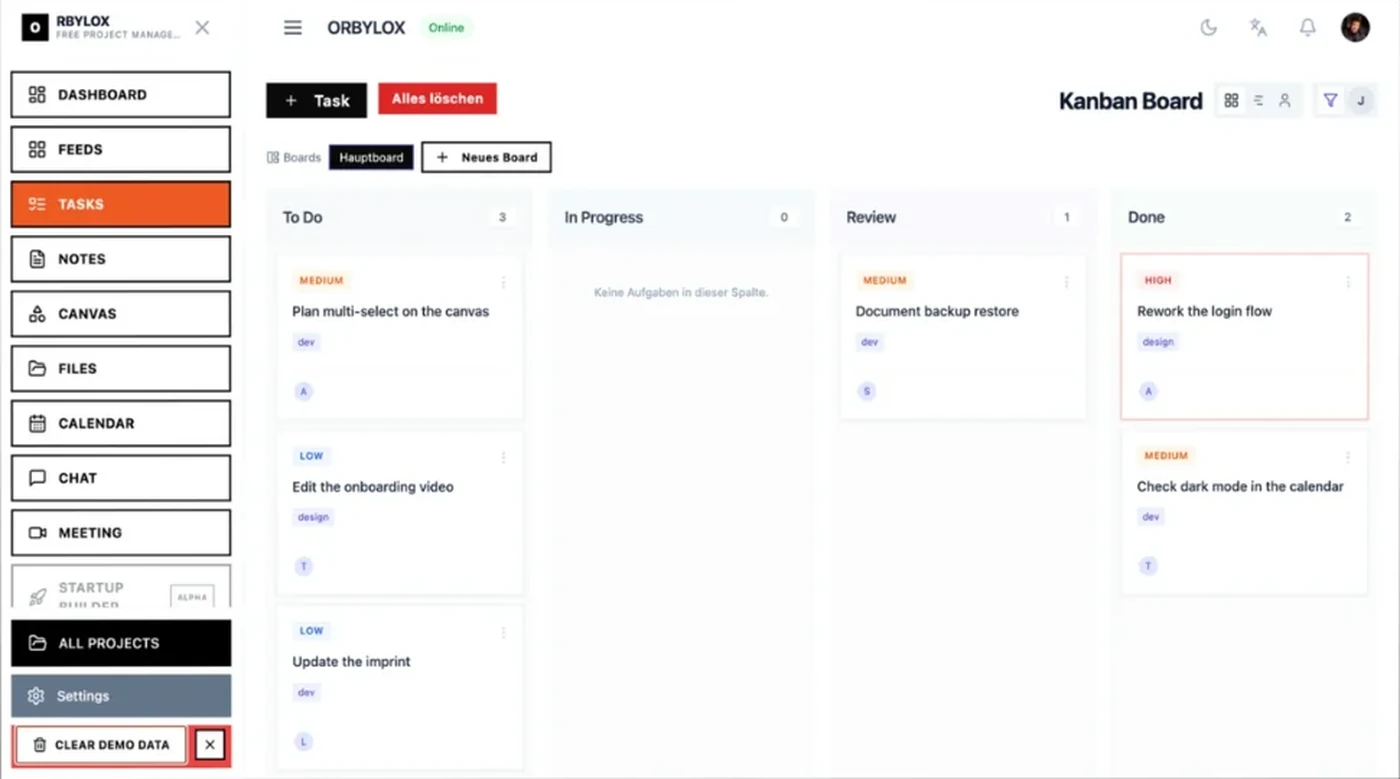
The numbers for "are we on plan?" are already on the board: done versus open tickets, story points per column. Blockers are recorded as dependencies and therefore visible, instead of living in one person's head.
Filing the report as a note inside the project gives you next week's template — and the run of the last eight reports shows at a glance whether amber was the exception or the normal state.