Sharing out work in a team: one rule, one template
The most common answer to "who is doing this?" is silence. Not because nobody wants to — but because four people each assume one of the other three was meant.
Task allocation is not an org chart. It is a list of sentences in the form: this task, this person, this date. Anything vaguer than that is not an allocation, it is a hope.
Why tasks stall
Three causes, in this order:
- Nobody is named. The task is on the board, but without a name. Everyone sees it, nobody owns it.
- Too many are named. "Lena and Tom will do it together" often means in practice: neither starts, because each waits for the other.
- The named person does not know. Assigned in the tool, never said out loud. Someone who has not seen their own name does not have the task.
None of these is a motivation problem. All three are assignment problems, and those can be fixed.
The one rule
A task has exactly one accountable person.
Not one worker — several people can work on it. One accountable person: the one you ask when you want to know where it stands. They do not have to do the work themselves. They have to know where the work is.
The moment two names sit on a task, "how is it going?" no longer has one clear answer. That is exactly where the task dies.
RACI, without the consultant baggage
RACI is four letters for four roles. It has a bad reputation because it usually shows up as a sixty-row table nobody maintains. Kept small, it is useful:
| Letter | Role | How many |
| R — Responsible | does the work | one or more |
| A — Accountable | owns the outcome | always exactly one |
| C — Consulted | asked beforehand | few |
| I — Informed | told afterwards | any number |
The only row that really matters is A. If you drop the other three and record only who answers for each work package, you have ninety percent of the value.
Template to copy
For a small team this table is enough. One row per work package, not per task — otherwise it grows too long and nobody maintains it.
| Work package | Accountable (A) | Working on it (R) | Ask first (C) | Done by |
| Homepage design | Lena | Lena, Tom | Client | Sep 24 |
| Menu copy | Tom | Tom | Kitchen | Sep 27 |
| Table booking | Jey | Jey, Lena | — | Oct 4 |
| Legal pages review | Jey | Accountant | — | Oct 6 |
Four columns you can fill in five minutes. If a row cannot be filled because it is unclear who is accountable — you have found exactly what this table is looking for.
How much can one person carry?
A rule of thumb that holds up: nobody is accountable for more than three running work packages at once.
This is not a statement about diligence. It is a statement about attention: whoever owns four things at once loses track of one of them, and you cannot tell in advance which one.
Count the A column. If one name appears seven times, that is not an allocation plan, it is a bottleneck with table formatting.
The sentence missing from most handovers
Assigning is not the same as handing over. A handover needs three things, and if one is missing the task comes back:
- What exactly is done? Not "write the copy", but "18 dishes described, allergens checked, filed in the document".
- By when? A date, not "this week".
- What if it gets stuck? Who to turn to without waiting.
Those three fit into two sentences. They save the follow-up question that otherwise arrives three days later.
When to reallocate
Task allocation is not a one-off act. Two occasions call for a review:
When someone drops out. Illness, holiday, resignation. The A column tells you immediately what stops without that person — that is its second use.
When a task has been postponed twice. Twice postponed almost never means "not enough time". It usually means: cut wrong, assigned wrong, or blocked by something nobody wrote down.
In ORBYLOX
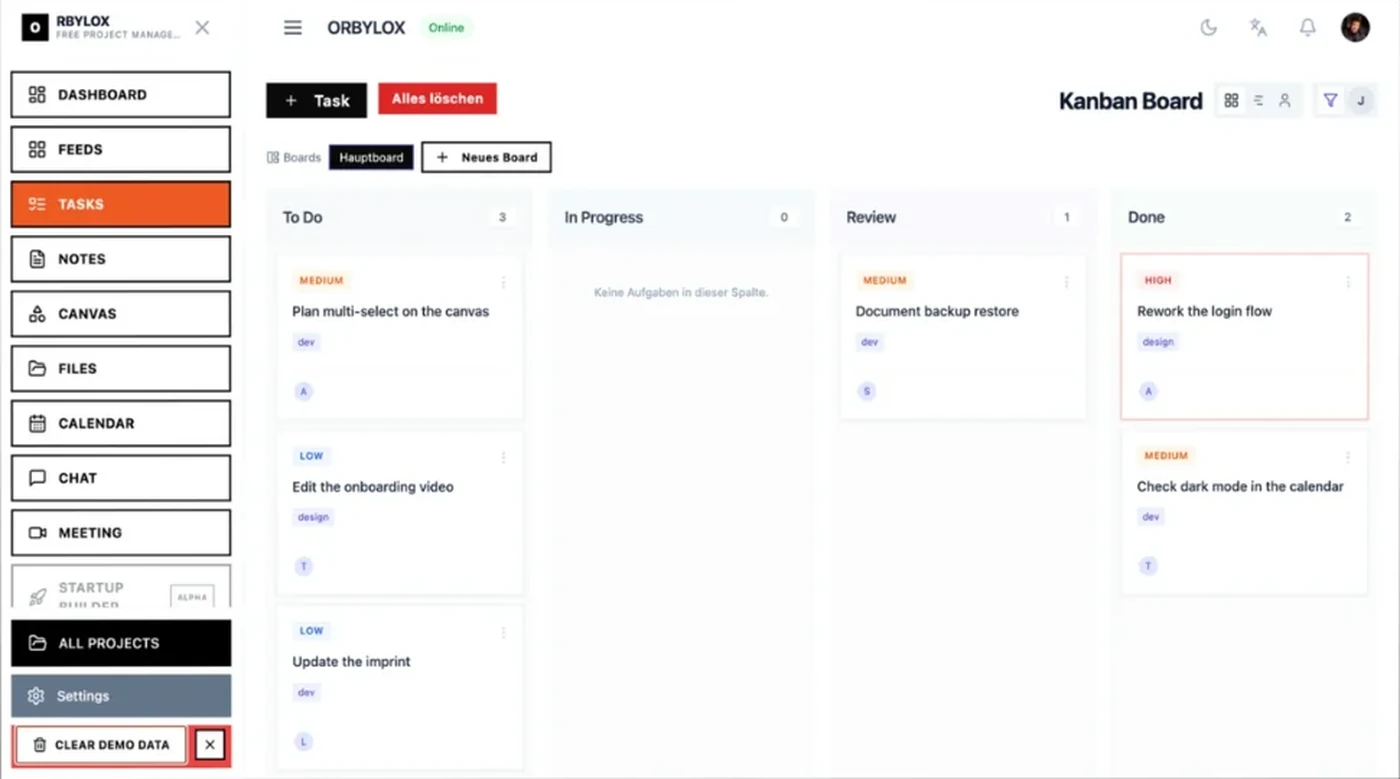
Every ticket has exactly one field for the accountable person and one due date. Whoever gets assigned receives an email — so the handover does not only happen in the tool, it reaches the human.
The filter bar shows the board filtered by person: that is the A column in card form, and it exposes bottlenecks faster than any table. If a project goes untouched for more than a week, the list says so on its own.
Task allocation is ultimately unspectacular: a name, a date, a clear sentence about what done means. The effort is not in the tool. It is in sitting with the uncertainty that becomes visible while you fill it in.